Referral partnership first video meeting agenda
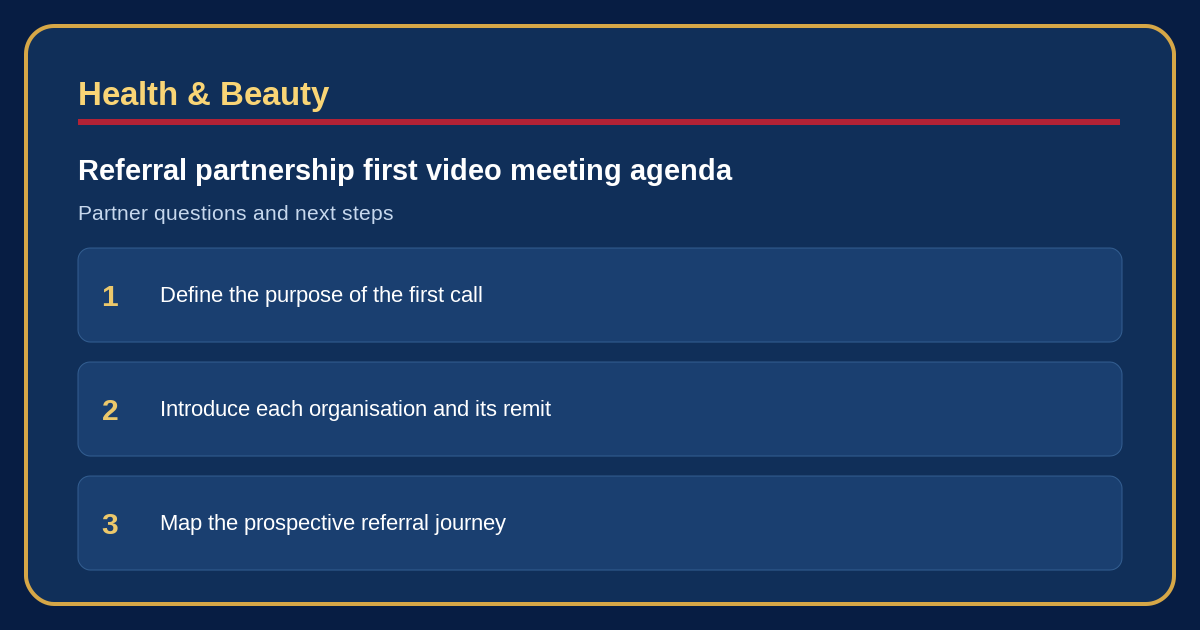
Define the purpose of the first call
A first video meeting between prospective referral partners works best when it is exploratory rather than a sales presentation. The organiser should circulate a short agenda, identify participants and state the intended outcome: deciding whether further due diligence is worthwhile. Health & Beauty can explain its coordination role while inviting the other organisation to describe its clients, geographical reach and existing services. No patient details are needed for this introductory discussion. Allowing time for questions often reveals practical concerns that polished promotional material would miss. Before the call, identify who may take notes and where those notes will be retained. An introductory meeting should use fictional examples rather than information about identifiable prospective patients. That makes it easier to discuss the workflow without creating an unnecessary patient record.
Introduce each organisation and its remit
Each participant should explain their legal entity, operating location, professional background and decision-making authority. A beauty salon, independent adviser and regulated clinical provider may all have very different responsibilities. Ask who would sign any agreement and whether additional compliance approval is required. It is useful to distinguish the person who manages enquiries from the person authorised to approve commercial terms. This avoids leaving a meeting with apparent agreement that neither attendee can implement.
Map the prospective referral journey
Walk through a hypothetical enquiry without using a real person's medical history. Who receives the initial request? What information is shared, through which channel, and at what point does the prospective patient communicate directly with a clinical provider? Consider what happens when a person changes their mind, requests a different language or needs an accessible appointment. The aim is to identify handovers, not to promise a seamless pathway before systems and responsibilities have been checked.
Discuss boundaries around clinical advice
An introductory partner must not assess eligibility for surgery merely because a client asks for an opinion. Clinical suitability, informed consent, treatment alternatives and individual risks belong with appropriately qualified clinicians. During the call, establish which statements partners may make publicly and which questions must be referred onwards. Avoid fixed outcome promises or claims that treatment is suitable for everyone. A written boundary statement can later form part of training and partnership documents.
Agree information governance expectations
Discuss the categories of personal data that might be exchanged, not individual records. UK organisations should consider UK GDPR obligations, lawful bases, special-category data conditions and appropriate security controls. Ask whether both sides have a privacy notice, a responsible contact and a process for access or deletion requests. The first call is not the place to upload medical images or passports. A separate data-flow assessment can follow once the proposed service is clear. If a UK partner proposes transferring identifiable information abroad, flag that question for a separate UK international-transfer assessment rather than assuming a commercial agreement supplies the appropriate safeguards. Health information requires special-category processing analysis in addition to an Article 6 lawful basis.
Test communication and escalation routes
Agree a provisional contact for routine scheduling and another route for urgent concerns. A referral partner should know how to flag a missed handover, a disputed quotation or a communication breakdown. Medical emergencies require appropriate local emergency or clinical services rather than an ordinary commercial inbox. Test whether language support, time-zone differences and public holidays affect response expectations. These details are often more revealing than a broad assurance of round-the-clock availability.
Close with documented next actions
Finish by reading back the decisions and unresolved questions. Assign a named owner and realistic due date to each action, such as sending company registration details, sample service descriptions or a proposed data-sharing outline. Record that commercial terms and clinical arrangements remain subject to review. Share concise minutes through an agreed secure channel and invite corrections. A successful first meeting creates a reliable basis for a second discussion; it does not need to produce an immediate referral contract.
An optional final check is to ask each attendee to explain the proposed next step in their own words. Differences can then be resolved before anyone relies on the minutes.
Sources and references
https://ico.org.uk/for-organisations/uk-gdpr-guidance-and-resources/lawful-basis/special-category-data/
Partner with Health & Beauty
Discuss a potential collaboration and practical requirements directly with our team.