Clinical escalation for referral agencies
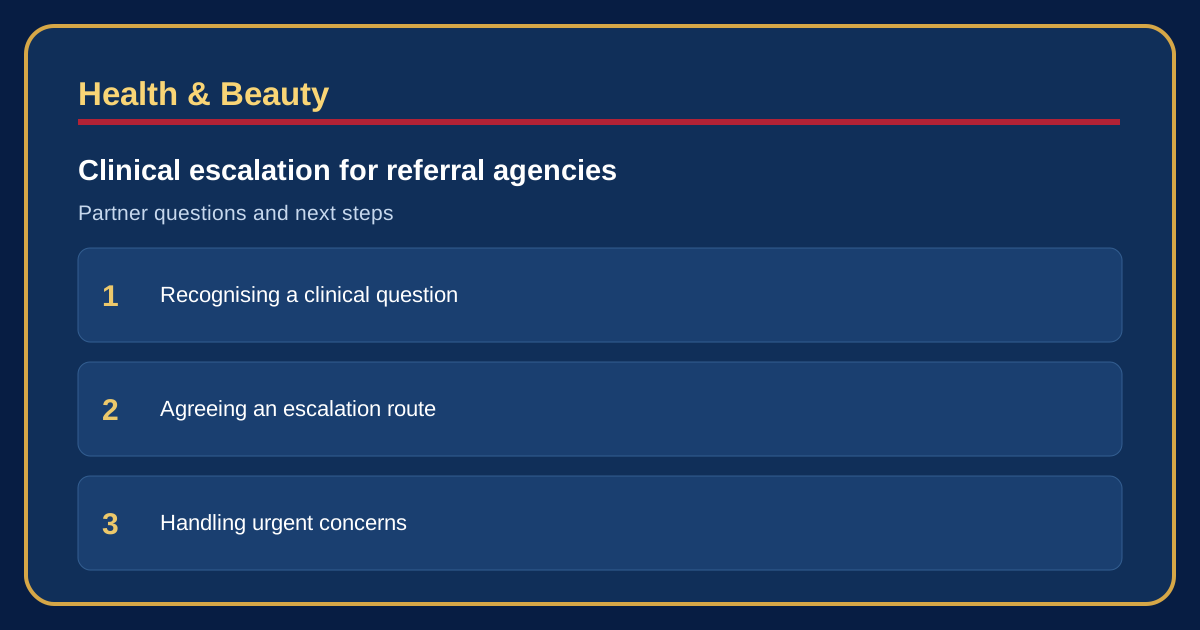
Recognising a clinical question
A referral agency may explain how a consultation is booked, which documents are requested and whom to contact. It should not decide whether a symptom is harmless, whether medication should change or whether a procedure is suitable. A practical boundary is to ask whether answering requires clinical judgement about an individual. If it does, the question belongs with a qualified clinician. The agency can record the question faithfully and help the person reach the correct team without translating uncertainty into reassurance. For example, a caller asking whether to stop prescribed medicine should receive the clinician's contact details and a clear explanation that the coordinator cannot advise on dosage. Staff should note the enquiry time and check that the clinical team has received it.
Agreeing an escalation route
Before accepting enquiries, partners should identify a named clinical contact or a monitored clinical inbox, coverage hours, an alternative during absences and a route for urgent concerns. A generic sales mailbox is not a substitute for clinical triage. The written arrangement should distinguish routine pre-consultation questions from time-sensitive concerns. Staff need an escalation instruction they can follow without interpreting symptoms. If the designated contact cannot be reached, the agency should say so clearly rather than promise a medical answer.
Handling urgent concerns
Where someone describes an immediate danger or rapidly worsening condition, staff should direct them towards local emergency services or appropriate urgent healthcare rather than wait for an overseas provider to reply. The agency must not attempt remote diagnosis. For less urgent matters, the referral should include the person's own words, their preferred contact route and the time of the enquiry. A documented handover reduces the chance that an unanswered message is mistaken for a completed clinical assessment.
Obtaining consent for a handover
Medical details are sensitive. Ask what information is actually needed, explain who will receive it and use an appropriate lawful basis and secure channel. A person seeking a general price range need not disclose an entire medical history to a marketing partner. Where consent is relied on, record its scope and any withdrawal; other legal bases may apply and require specialist assessment. Keep business correspondence separate from clinical files and restrict access to staff with a genuine operational role.
Recording the clinical response
A useful record identifies the question, the person or team to whom it was forwarded, the date, the response received and whether the patient was contacted. Preserve the clinician's wording and do not convert a conditional statement into a treatment promise. If an answer is incomplete, ask the clinical team to clarify it. Avoid copying sensitive material into multiple chat groups. The purpose of the record is traceability, not the creation of an unofficial medical opinion by the agency.
Explaining the agency's role
Public pages and partner scripts should describe coordination as coordination. Health & Beauty can help organise enquiries and communication, while medical assessment, diagnosis, informed consent and treatment decisions remain with the responsible healthcare professionals. A clear explanation also covers who handles complaints about booking arrangements and who handles clinical concerns. Such separation protects the prospective patient from confusing a helpful administrative contact with a medical practitioner.
Reviewing incidents and training
Test the escalation process using realistic examples, such as a question about stopping prescribed medicine, an unanswered clinical email or a request for postoperative advice. Review whether staff used the correct route, whether the recipient acknowledged the handover and whether personal information was limited. Update contact details whenever clinical partners change. Training should reinforce the right to say that an answer requires a clinician. Documented reviews are more useful than an unsupported promise of round-the-clock medical support.
Sources and references
https://ico.org.uk/for-organisations/uk-gdpr-guidance-and-resources/
Partner with Health & Beauty
Discuss a potential collaboration and practical requirements directly with our team.