Decision guide: Patient record access in a provider referral wor — questions a referring professional can clarify w | when documenting the treatment
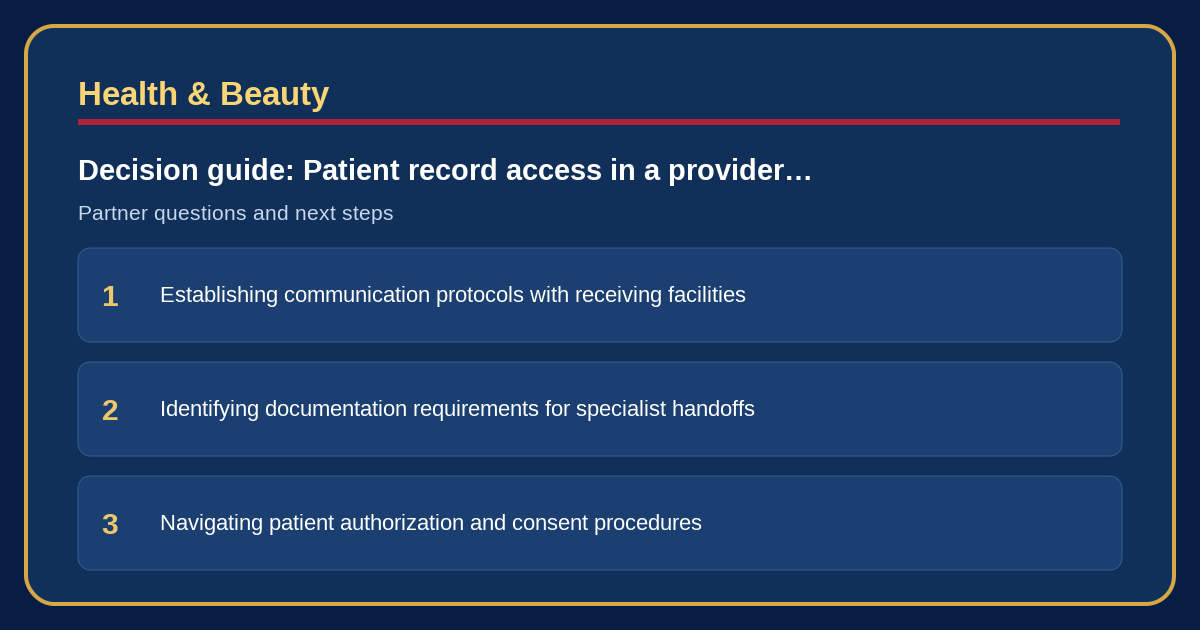
For a medical care coordinator when documenting the treatment decision: Patient record access in a provider referral workflow. Specific question: questions a referring professional can clarify with the care team. Health & Beauty coordinates administrative and travel services only; medical decisions are made by licensed clinicians. Health & Beauty does not operate clinics. When coordinating care pathways across multiple facilities, professionals frequently encounter procedural uncertainties regarding how clinical data moves between specialists. Clarifying these operational communication channels protects patient privacy and ensures that treating teams receive accurate health histories without unnecessary administrative delays or unauthorized disclosures.
Establishing communication protocols with receiving facilities
Clear administrative communication lines are essential before transferring any documentation between independent healthcare entities. Care coordinators should proactively establish who at the receiving clinic acts as the primary point of contact for administrative inquiries. Understanding specific transmission preferences prevents lost paperwork and minimizes the risk of misdirected communications. Administrative staff can verify whether secure electronic portals, encrypted messaging systems, or authorized facsimile numbers are required for initial inquiries. Establishing these baseline rules ensures that all subsequent administrative exchanges run smoothly, keeping the focus entirely on supporting the patient.
Identifying documentation requirements for specialist handoffs
Coordinators must determine precisely which clinical records are necessary for a specialist consultation. Different medical specialties require distinct diagnostic histories, surgical backgrounds, and baseline laboratory panels to evaluate incoming cases effectively. Rather than assuming standard packages apply, checking with the clinical administration helps prevent both under-documentation and the transfer of irrelevant personal data. Requesting a concise checklist of mandatory intake forms ensures that patient files remain streamlined. This targeted approach respects privacy boundaries while equipping the treating clinician with the exact information needed for comprehensive clinical evaluation.
Navigating patient authorization and consent procedures
Valid authorization forms are the cornerstone of lawful health information exchange between separate provider organizations. Coordinators should review internal policies to confirm that patient consent documentation clearly specifies which entities may share records and for what duration. If consent forms lack specific destination details or expiration dates, administrative teams must obtain updated documentation directly from the individual before proceeding. Ensuring that every disclosure aligns precisely with the patient's written instructions maintains trust and upholds regulatory standards across every participating administrative and clinical environment.
Clarifying timelines for document transmission and review
Time management is critical when coordinating multi-facility care workflows and specialist appointments. Coordinators should ask receiving administrative teams about their typical processing windows for reviewing incoming referral records. Knowing whether a facility requires documentation twenty-four hours in advance or several business days prior to an appointment helps set realistic expectations for everyone involved. Clear scheduling communication prevents last-minute scrambles, reduces administrative stress for the patient, and ensures that treating clinicians have adequate time to review complex medical histories thoroughly before the consultation begins.
Managing data accuracy and error correction pathways
Discrepancies in medical records can occasionally occur during administrative transcription or multi-system data entry. Coordinators need to know the specific protocol for reporting and correcting inaccurate information discovered within a shared patient file. Establishing a direct channel for amendment requests ensures that corrections are documented systematically across all associated administrative platforms. When an error is identified, prompt communication with the health information management team allows both referring and receiving offices to maintain synchronized, reliable records without compromising ongoing clinical care or administrative oversight.
Understanding regulatory boundaries for information sharing
Navigating privacy regulations requires a thorough understanding of permissible disclosures within professional referral networks. Coordinators should consult institutional compliance officers to clarify the exact legal boundaries governing record access during inter-facility transfers. Knowing which documents can be shared routinely versus those requiring specialized individual authorization prevents compliance oversights. While Health & Beauty focuses purely on administrative and travel coordination, understanding these regulatory frameworks helps coordinators guide administrative processes responsibly, ensuring that all data handling practices consistently align with established federal privacy standards and institutional policies.
Practical steps for coordinating administrative record inquiries
When initiating a referral, coordinators benefit from maintaining a structured checklist of administrative questions to ask the receiving care team. Start by verifying the exact name and secure contact details of the designated intake coordinator at the destination facility. Next, confirm their preferred secure transmission format for clinical summaries and diagnostic test results. Inquire about expected processing timeframes to ensure documentation arrives well ahead of the scheduled appointment. Health & Beauty can assist with logistical planning and itinerary management while you finalize these administrative details. For further administrative assistance or to discuss logistical coordination services, you may contact Health & Beauty directly through our official communication channels.
Frequently Asked Questions
H3: What role does Health & Beauty play in the patient record access process?
Health & Beauty provides administrative and travel coordination services only. We do not make medical decisions, operate clinics, or handle direct clinical record transfers. All clinical determinations and data access protocols remain strictly under the authority of licensed healthcare providers and their authorized administrative staff.
H3: How can a coordinator verify the correct transmission method for referral records?
Coordinators should contact the designated administrative intake office at the receiving facility directly before sending any documents. Asking for their specific secure electronic portal requirements, encrypted email protocols, or verified fax numbers ensures that patient records are transmitted securely and in full compliance with institutional standards.
H3: What should be done if a discrepancy is found in transferred documents?
If an administrative or clinical discrepancy appears within shared paperwork, notify the health information management departments of both the referring and receiving facilities immediately. Follow their established formal amendment procedures to document and correct the record accurately across all participating administrative systems.
Sources and references
https://www.hhs.gov/hipaa/for-professionals/privacy/index.html
Partner with Health & Beauty
Discuss a potential collaboration and practical requirements directly with our team.