Data minimisation in international referral handovers
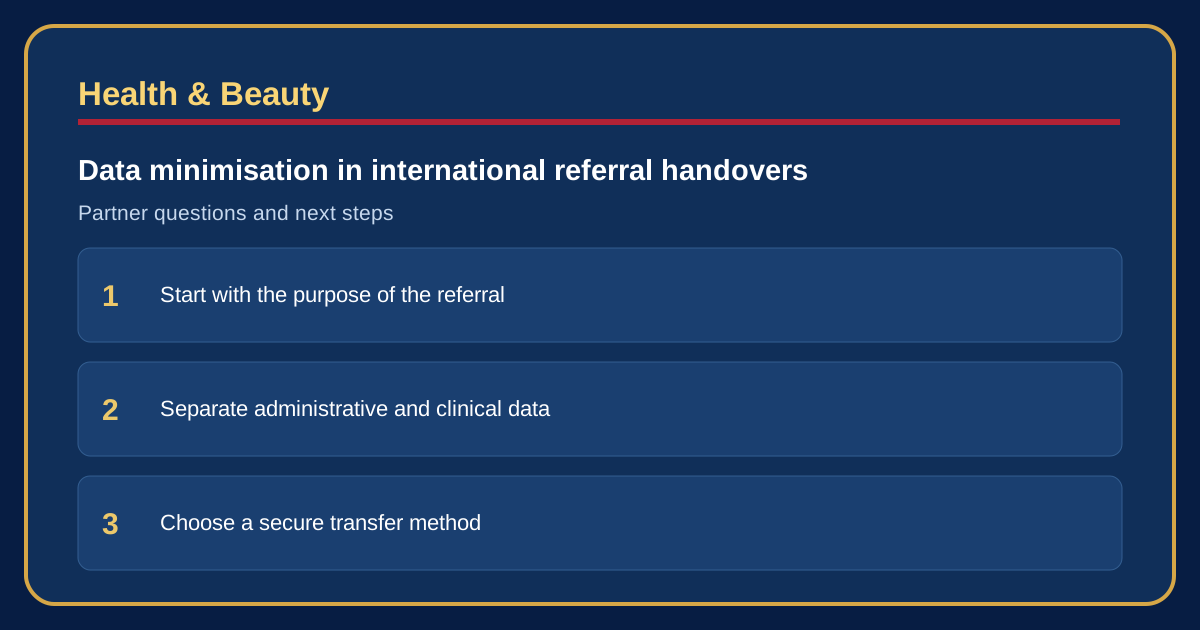
Start with the purpose of the referral
An international referral often begins with a simple request: arranging an introduction or checking whether a consultation can be scheduled. That purpose rarely requires a full clinical record at the first contact. Map each step from initial enquiry to clinician review and identify the minimum information necessary at that stage. A contact name, preferred language and a safe reply channel may be sufficient initially. Detailed health information should move only when a legitimate, clearly explained purpose requires it. For example, an initial request for an appointment can be routed without a passport scan or a medication history. If the receiving clinician later needs records, the patient should know precisely which documents are requested, by whom, and through which secure channel.
Separate administrative and clinical data
Booking coordinators may need appointment dates, accessibility requests and contact preferences. Clinicians may require medical history or test results to assess suitability. These datasets should not automatically be shared with the same people. Role-based access and separate storage locations make accidental disclosure less likely. A partner agreement should state which organisation collects each category, who may see it and when it should be transferred. Staff should resist copying entire email threads simply because forwarding is convenient.
Choose a secure transfer method
Avoid sending medical attachments through public group chats or to unverified addresses. Verify the recipient independently, use approved encrypted channels where available and check that access permissions are appropriate. Password protection is not a substitute for a complete information-security process. Provide clear instructions for recipients to acknowledge receipt without unnecessarily repeating clinical details. If a transfer fails, investigate the route before retrying; repeated messages to several addresses can multiply the exposure.
Explain the international dimension
Cross-border transfers may trigger additional UK GDPR or other applicable data protection requirements depending on the organisations and locations involved. A privacy notice should explain recipients, purposes, relevant safeguards and contact points in language the person can understand. Do not assume that a signed referral form alone resolves every legal obligation. Organisations should assess controller and processor roles and obtain appropriate advice for their particular transfer arrangements. The destination country and the actual receiving organisation both matter.
Make consent and choice understandable
Where consent is the selected legal basis, the request should be specific, informed and capable of being withdrawn where applicable. Other lawful bases may be relevant, and special-category health data require an additional condition. Avoid bundling consent to clinical communication with unrelated marketing permission. Tell people what happens if they choose not to send a document and whether an alternative is available. Record the explanation provided rather than relying solely on a pre-ticked box.
Set retention and correction rules
Define how long enquiry records and attachments are needed and who is responsible for deletion or secure archiving. A missed appointment should not leave copies of identity documents scattered indefinitely across personal inboxes. Provide a route for correcting inaccurate contact details and updating records. Where the clinical provider retains its own treatment record, distinguish that responsibility from the referral agency's administrative retention schedule. Keep an audit log of material disclosures without duplicating the sensitive content itself.
Check the handover in practice
Run a periodic sample review: was the recipient authorised, was the dataset proportionate, was the transfer acknowledged and could the individual find the privacy contact? Include procedures for misdirected emails and suspected breaches, with appropriate escalation and assessment of notification duties. Health & Beauty can coordinate an introduction without making itself the default archive for every medical document. A documented, limited handover is easier to explain, secure and correct than an unrestricted information exchange.
Sources and references
https://ico.org.uk/for-organisations/uk-gdpr-guidance-and-resources/
Partner with Health & Beauty
Discuss a potential collaboration and practical requirements directly with our team.