Referral consent and privacy: Permitted information sharing — questions for UK partners
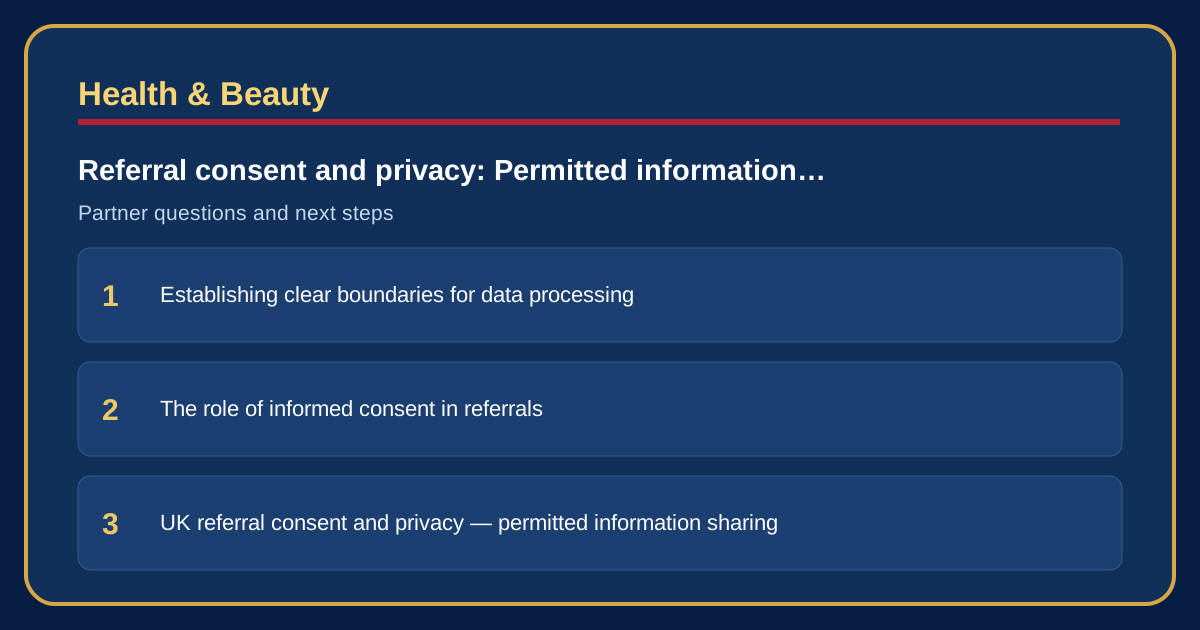
Navigating UK referral consent and privacy — permitted information sharing requires a clear understanding of data protection obligations. When managing professional partnerships, it is essential to distinguish between administrative coordination and clinical practice. Health & Beauty coordinates administrative and travel services only; medical decisions are made by licensed clinicians. Health & Beauty does not operate clinics. By maintaining this boundary, partners ensure that patient data remains secure and compliant with regulatory standards. Understanding these roles is the first step toward building a transparent, professional framework for all stakeholders involved in the referral process.
Establishing clear boundaries for data processing
The foundation of any professional partnership lies in defining the scope of data processing activities. When a referral is initiated, the administrative coordinator must only handle information necessary for logistical arrangements, such as travel or scheduling. Conversely, clinical data, including medical histories or diagnostic reports, must remain strictly within the purview of the treating clinician. By compartmentalising these data streams, organisations reduce the risk of unauthorised access. Partners should document these roles clearly to ensure that every participant understands their specific responsibilities regarding sensitive information.
The role of informed consent in referrals
Informed consent is not merely a checkbox; it is a fundamental requirement for lawful data processing. When sharing information between a referring partner and a service provider, the individual must be fully aware of who will receive their data and for what specific purpose. Consent must be freely given, specific, and informed. If the purpose of the data processing changes, a new consent process is often required. Partners should ensure that their documentation clearly outlines how data is used, providing individuals with control over their personal information.
UK referral consent and privacy — permitted information sharing
Adhering to UK referral consent and privacy — permitted information sharing standards requires rigorous attention to detail. Organisations must ensure that any transfer of personal data complies with the Data Protection Act and the UK GDPR. This involves verifying that the receiving party has appropriate security measures in place to protect the information. When sharing data for referral purposes, partners should only transmit the minimum amount of information required to facilitate the service. This principle of data minimisation is essential for maintaining trust and regulatory compliance.
Managing administrative versus clinical data flows
A common challenge in professional partnerships is the blurring of lines between administrative and clinical data. Administrative data typically includes contact details and logistical preferences, while clinical data encompasses health records and treatment plans. It is vital that these two categories are managed through distinct channels. Administrative coordinators should never access clinical notes, and clinicians should only receive the administrative data necessary to perform their duties. Establishing these separate workflows prevents accidental data exposure and ensures that each party operates within their professional remit.
Transparency and communication with individuals
Transparency is a cornerstone of data protection. Individuals have a right to know how their data is being processed, who is responsible for it, and how long it will be retained. Partners should provide clear privacy notices that explain these processes in plain language. If a referral involves multiple parties, the privacy notice must explicitly identify each entity and their respective roles. Open communication helps to build confidence, ensuring that individuals feel secure in the knowledge that their personal information is being handled with the utmost care.
Security measures for digital data transfers
Digital security is paramount when sharing information between partners. Using secure, encrypted channels for data transmission is a non-negotiable requirement. Partners should avoid sending sensitive information via standard email unless it is protected by robust encryption protocols. Furthermore, access to shared databases or portals should be strictly controlled through multi-factor authentication and role-based access permissions. Regularly auditing these security measures ensures that they remain effective against evolving threats. If you have questions regarding our administrative coordination processes, please contact the Health & Beauty team directly for guidance.
Ensuring compliance through regular internal audits
Compliance is an ongoing process rather than a one-time achievement. Partners should conduct regular internal audits to review their data handling practices and ensure they align with current regulatory requirements. These audits should examine how consent is obtained, how data is stored, and whether the information shared is truly necessary for the intended purpose. By proactively identifying and addressing potential vulnerabilities, organisations can maintain high standards of data protection. If a discrepancy is identified, it should be corrected immediately to uphold the integrity of the partnership.
Frequently Asked Questions
What is the primary difference between administrative and clinical data handling?
Administrative handling focuses on logistical details like travel and scheduling, which Health & Beauty manages. Clinical data, such as medical records and treatment decisions, must be handled exclusively by licensed clinicians. This separation ensures that sensitive health information is only accessed by those qualified to interpret and act upon it.
How should partners obtain valid consent for data sharing?
Consent must be specific, informed, and freely given. Partners should provide clear documentation explaining exactly what information is being shared, why it is necessary, and who will receive it. Individuals must have the option to withdraw their consent at any time without facing negative consequences.
What steps should be taken if a data breach is suspected?
If a breach is suspected, the organisation must immediately assess the scope of the incident. Under UK law, certain breaches must be reported to the Information Commissioner’s Office within 72 hours. Partners should have a pre-defined incident response plan to ensure a swift and compliant reaction.
Sources and references
https://ico.org.uk/for-organisations/direct-marketing-and-privacy-and-electronic-communications/direct-marketing-guidance/collect-information-and-generate-leads/
Partner with Health & Beauty
Discuss a potential collaboration and practical requirements directly with our team.