Partner onboarding: Introductory meeting agenda — practical questions for US partners
Navigating a US partner onboarding — introductory meeting agenda requires clear communication, defined professional boundaries, and transparent administrative alignment. Health & Beauty coordinates administrative and travel services only; medical decisions are made by licensed clinicians. Health & Beauty does not operate clinics. During initial consultations, collaborative US partners often review operational frameworks, participant communication workflows, and digital documentation standards. Establishing a structured agenda guarantees that every administrative detail is thoroughly addressed, supporting efficient workflows while respecting the independent clinical judgment of treating medical professionals across all participating facilities.
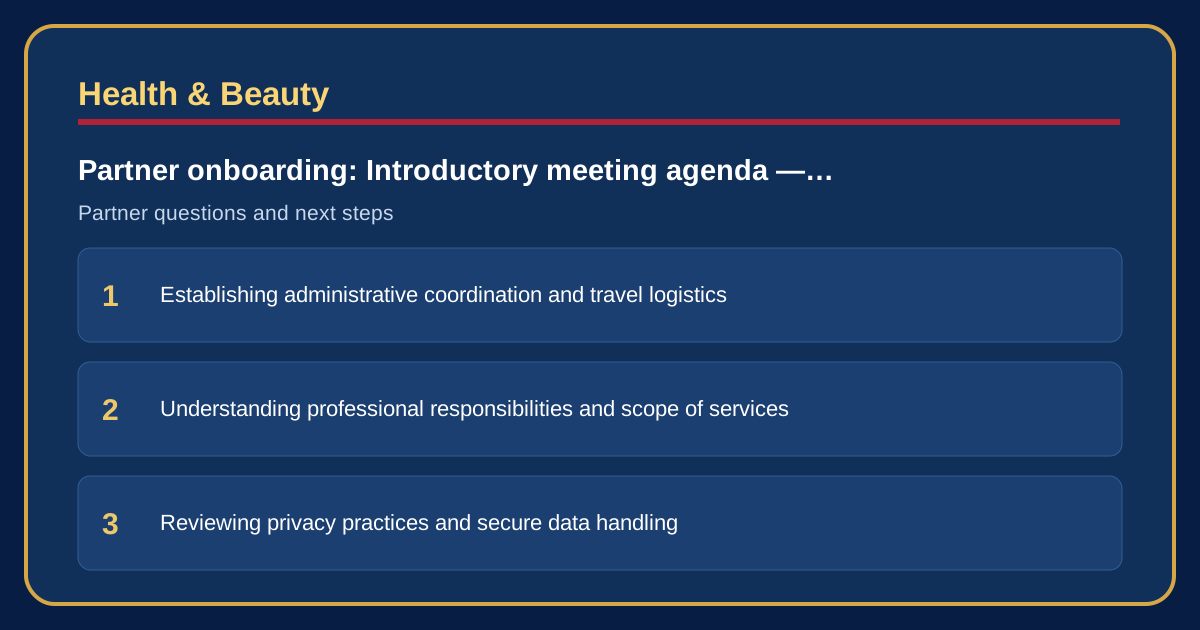
Establishing administrative coordination and travel logistics
Administrative coordination forms the foundational baseline for any effective working relationship. During the initial introductory meeting, partners should discuss how scheduling, itinerary planning, and ground transportation requests are managed on a day-to-day basis. Clarifying who acts as the primary point of contact for routine operational questions helps streamline communication between all parties. Reviewing these logistical workflows early prevents misunderstandings and ensures that participants experience a seamless transition from their initial inquiry through their arrival at the designated facility, keeping administrative tasks strictly separated from clinical oversight.
Understanding professional responsibilities and scope of services
Defining clear professional boundaries is essential for maintaining integrity and operational transparency. Partners must review the specific administrative functions provided by the coordinating organization versus the independent duties handled by licensed medical staff. Because Health & Beauty coordinates administrative and travel services only; medical decisions are made by licensed clinicians, and Health & Beauty does not operate clinics, alignment on these boundaries is mandatory. Participants should discuss how inquiries are triaged, ensuring clinical questions are routed directly to qualified practitioners while routine operational matters remain with administrative coordinators.
Reviewing privacy practices and secure data handling
Protecting sensitive participant information is a critical component of any professional onboarding process in the United States. Partners need to evaluate existing communication channels, document storage protocols, and data transfer methods to confirm they align with relevant privacy standards. Discussing how records are transmitted securely between administrative staff and medical facilities prevents potential vulnerabilities. The meeting should cover who has authorized access to specific files and outline standard retention practices, ensuring that all handled data remains strictly confidential and protected against unauthorized disclosure throughout the coordination lifecycle.
Aligning communication workflows for optimal participant support
Clear communication channels ensure that participants receive timely updates regarding their travel schedules and administrative arrangements. The introductory meeting should outline the preferred methods for day-to-day correspondence, status reporting, and urgent notification procedures. Establishing structured check-ins helps monitor the efficiency of the coordination process without interfering with clinical care delivery. Partners can discuss how feedback is gathered and addressed, creating a continuous improvement cycle that enhances overall service quality while maintaining absolute separation between administrative support and independent medical evaluations.
Addressing scheduling protocols and availability parameters
Managing timelines effectively requires a transparent understanding of operational hours, response time expectations, and scheduling buffers. Partners should review how booking requests are submitted, acknowledged, and confirmed within agreed-upon timeframes. Discussing calendar management strategies helps prevent bottlenecks during peak periods and ensures that travel itineraries match facility availability. While administrative coordinators handle logistics, any questions regarding medical timing, recovery milestones, or treatment prerequisites must always be directed to the licensed clinicians responsible for direct participant assessment and personalized clinical care plans.
Clarifying documentation standards and record accuracy
Accurate documentation underpins every successful administrative partnership. During this segment of the onboarding agenda, participants should examine the standard templates, intake forms, and confirmation letters utilized throughout the coordination process. Establishing uniform formatting guidelines minimizes errors and ensures that all administrative records remain complete and easily accessible to authorized personnel. Reviewing these paperwork requirements also helps identify potential workflow improvements, ensuring that every administrative document accurately reflects the logistical scope without overstepping into clinical observations or medical determinations.
Planning ongoing collaboration and scheduled review sessions
Sustaining a productive partnership requires regular evaluation of operational performance and administrative alignment. The concluding portion of the introductory meeting should focus on establishing recurring check-in schedules, performance feedback loops, and protocol review milestones. Partners can discuss how future adjustments to travel coordination or administrative workflows will be proposed and implemented. To begin this collaborative journey, you are invited to connect with the Health & Beauty team for a low-pressure introductory discussion regarding administrative coordination services; please reach out through our official channels to schedule your consultation today.
Frequently Asked Questions
### What topics should be covered during a partner onboarding meeting?
An introductory meeting should focus on administrative coordination, travel logistics, data privacy protocols, communication workflows, scheduling procedures, and documentation standards. It establishes clear operational boundaries and ensures all participating parties understand their specific responsibilities from the very beginning.
### Who is responsible for medical decisions during partner onboarding?
Medical decisions are strictly the responsibility of licensed clinicians. Health & Beauty coordinates administrative and travel services only; medical decisions are made by licensed clinicians, and Health & Beauty does not operate clinics or provide clinical advice.
### How are privacy and data security handled during onboarding?
Partners review secure communication channels, authorized access controls, and data transmission protocols to ensure participant information remains confidential and protected in accordance with established United States privacy regulations and administrative standards.
Source: https://www.hhs.gov/hipaa/for-professionals/privacy/index.html
Sources and references
https://www.hhs.gov/hipaa/for-professionals/privacy/index.html
Partner with Health & Beauty
Discuss a potential collaboration and practical requirements directly with our team.